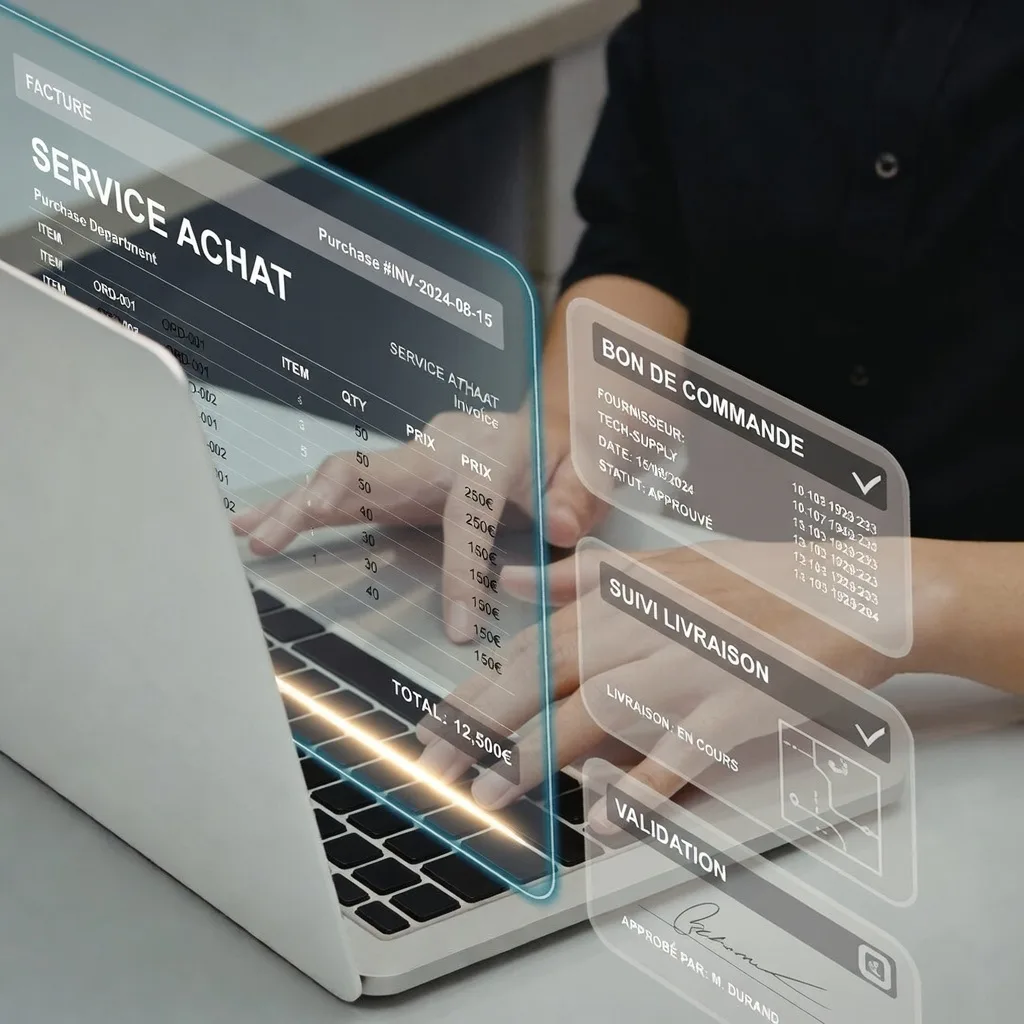

If the profitability of your business depends in part on the negotiations you conduct with suppliers, one parameter is too often neglected even though it carries real weight: the comparison between invoices received and the original quotes. Securing a negotiated rate is a first satisfaction. That rate still has to be the one actually invoiced, line after line, for the whole duration of the agreement. That is where a successful negotiation becomes, or fails to become, a cost reduction.
If you manage a substantial procurement budget, or if you negotiate for an entity made up of several profit centres, integrated or franchised, what follows concerns you directly.
Bringing AI into the purchasing process
Once the pricing terms of a quote have been validated, once the partnership has been signed around a supply or a service at a price both parties consider reasonable, comes the time to perform the reciprocal obligations. Your supplier commits to deliver or carry out what was quoted; you commit to pay for it under the agreed conditions.
The first action, once the contractor’s obligation has been fulfilled, is to check that what was delivered or performed matches what was planned. That check generally precedes receipt of the invoice for the service. This is the right moment to bring AI into the process: before the invoice is approved, not after it has been paid.
AI steps in before the invoice arrives
When a quote is validated, AI turns it into a set of data ready for comparison, whatever layout the supplier chose: that is the role of Capture, which extracts every line (reference, quantity, unit, price, rebate, terms) and keeps it linked to the exact place in the document where it was read.
Then, when the invoice arrives, the cross-check consists of confronting every invoiced price line with the rates negotiated and validated on the original quote. This is the precise moment where AI reduces costs, because the point is not merely to compare an invoice total with a quote total. The point is to spot, without delay:
- the gaps between the content of the negotiated service and the content of what was supplied or delivered;
- the origin of the gaps that explains the difference between the invoiced amount and the negotiated rate;
- the precise invoice lines that raise a problem;
- the data that is inconsistent between what was planned and what was supplied: a price per kilo changed by a few cents, transport charges added, a VAT error.
Where a spreadsheet compares totals, AI extracts from the invoice the marginal data behind the gap between the quote amount and the invoice amount. It does not merely flag that an amount is wrong: it points to the line that contradicts the negotiated terms, and displays the quote line and the invoice line side by side. You can not only identify an invoicing error, but justify it to the supplier, with proof.
Reducing costs means identifying the origin of the error
This investigative capacity is not there to hunt down unscrupulous suppliers or inattentive buyers. It is a tool that benefits every party involved in the purchasing process, for two reasons.
The indexed price. If a rate was negotiated from a price per kilo, and AI finds a gap between the quote and the invoice received, two explanations are possible: either the supplier did not inform the client of a change in the market price, or the buyer did not contractually fix a price independent of market fluctuations. In both cases, the documented gap serves to revisit future purchasing terms, not only to claim a credit note.
The network. If a rate was negotiated at group level for several franchised profit centres, every entity benefits from the same control: AI compiles the invoices received by each centre, extracts their data and confronts it with the terms negotiated by head office. The penalised profit centres are identified, with the lines concerned. For a head office, being able to name the cause of a financial loss and inform the members of its network, with proof, counts as much in credibility as in cost reduction.
What changes, and what does not
What changes is coverage: control no longer depends on the time available to reread a sample of invoices; it covers all the invoices received. On the scopes we have analysed, recovered margin sits between 1 and 7% of the scope analysed: a bound observed on real data, not a promise.
What does not change is the decision. Zylio prepares the case and shows the proof; the buyer or the accountant decides. Nothing is committed without approval, no supplier is contacted, the ERP is not modified, and your data is never used to train a model.
To see this control at work on your own quotes and invoices, book a demo: twenty minutes, on your documents.