
Procurement, Finance & Accounting Digitalization: Why Traditional Tools Are No Longer Enough
Since its emergence at the heart of the industrial revolution in the 19th century, the purchasing function has undergone a profound and continuous transformation. Initially confined to a purely administrative role: placing orders, paying suppliers, etc., it has gradually established itself as a strategic lever in its own right: defending competitive advantage, proactively managing supplier risks, monitoring the market, contributing to innovation. But this rise in power is accompanied by increasing pressure: more data to process, more criteria to analyze, more regulatory requirements to integrate. And the tools available to purchasing departments today are no longer equal to these challenges.
The development of the purchasing functionis still far from complete, and requires increasing responsiveness linked to the challenges it faces, particularly in terms of performance as well as theautomation of operational tasks, as Manutan, the blog for purchasing experts, points out in its article “How has the purchasing function evolved since the 1850s?“
Current tools and their limitations
The purchasing function relies on a range ofdigital tools that have become essential for structuring and managing activities. Among the most widely used are ERP, e-procurement platforms and analysis tools.
These digital solutions have made it possible to digitize purchasing processes, improve traceability and better control expenditure. They provide better visibility of flows, facilitate supplier management and ease a number of administrative tasks.
However, despite these advances, these tools still have significant limitations that are hard to ignore.
Firstly, they are mainly based on descriptive logic. Decisions remain largely dependent on human intervention, particularly forsupplier analysis, negotiation andrisk identification.
These tools often operate on the basis of predefined rules, lacking flexibility in the face of complex or unforeseen situations, such as supply disruptions, price fluctuations or geopolitical crises.
Furthermore, the quality of results depends heavily on the quality of the data entered. Incomplete or erroneous data can severely limit the relevance of analyses and decisions, and be the source of many errors.
So, although today’s tools have enabled a major transformation of the purchasing function, they are now reaching certain limits. It is in this context that the integration ofArtificial Intelligence appears to be a natural evolution to make purchasing more predictive, more agile and more strategic.
The explosion of supplier data
As the scope and role of the purchasing function have expanded, the volume and complexity of supplier data to be processed has grown exponentially.
With the expansion of supplier panels, the multiplication of contractual reference documents (framework contracts, BPU, DPGF, CCTP), pressure on supply costs, CSR requirements and regulatory compliance (CSRD, CS3D), buyers today are navigating in an environment of unprecedented information density.
Tools such as ERPs, e-procurement platforms and analysis tools help to centralize this information, but exploiting it often remains complex.
The problem is not just quantitative. It is also qualitative and structural:
- Data is scattered: ERP, purchasing tools, Excel files, emails, make consolidation laborious and consistency time-consuming.
- Data reliability is variable: data entry errors, obsolete information, duplication. An imperfect database produces imperfect analyses.
- Evaluation criteria have multiplied: Evaluating a supplier is no longer simply a matter of comparing price or lead time. Regulatory compliance, environmental performance, supply chain risks and the financial strength of the partner must all be taken into account.
This growing complexity often exceeds the capabilities of traditional tools and human analysis alone. Buyers find themselves faced with a mass of information that is difficult to exploit effectively, leading to time-consuming tasks that can slow down decision-making, increase risk and waste time on high value-added missions.
In this context, supplier data management has become a major strategic challenge for the purchasing function, requiring tools capable not only of centralizing information, but also of structuring it, making it reliable and analyzing it intelligently.
AI technologies
Faced with the limitations of traditional and digital tools, as well as the growing complexity of supplier data, Agentique Artificial Intelligence is emerging as a major lever for transforming the purchasing function, rather than just another tool.
In concrete terms, AI is capable ofanalyzing large quantities of data in real time, in order to identify trends, detect anomalies or forecast supplier risks. It can, for example, anticipate supply disruptions, recommend alternative suppliers, suggest cost optimization opportunities or identify inconsistent variances.
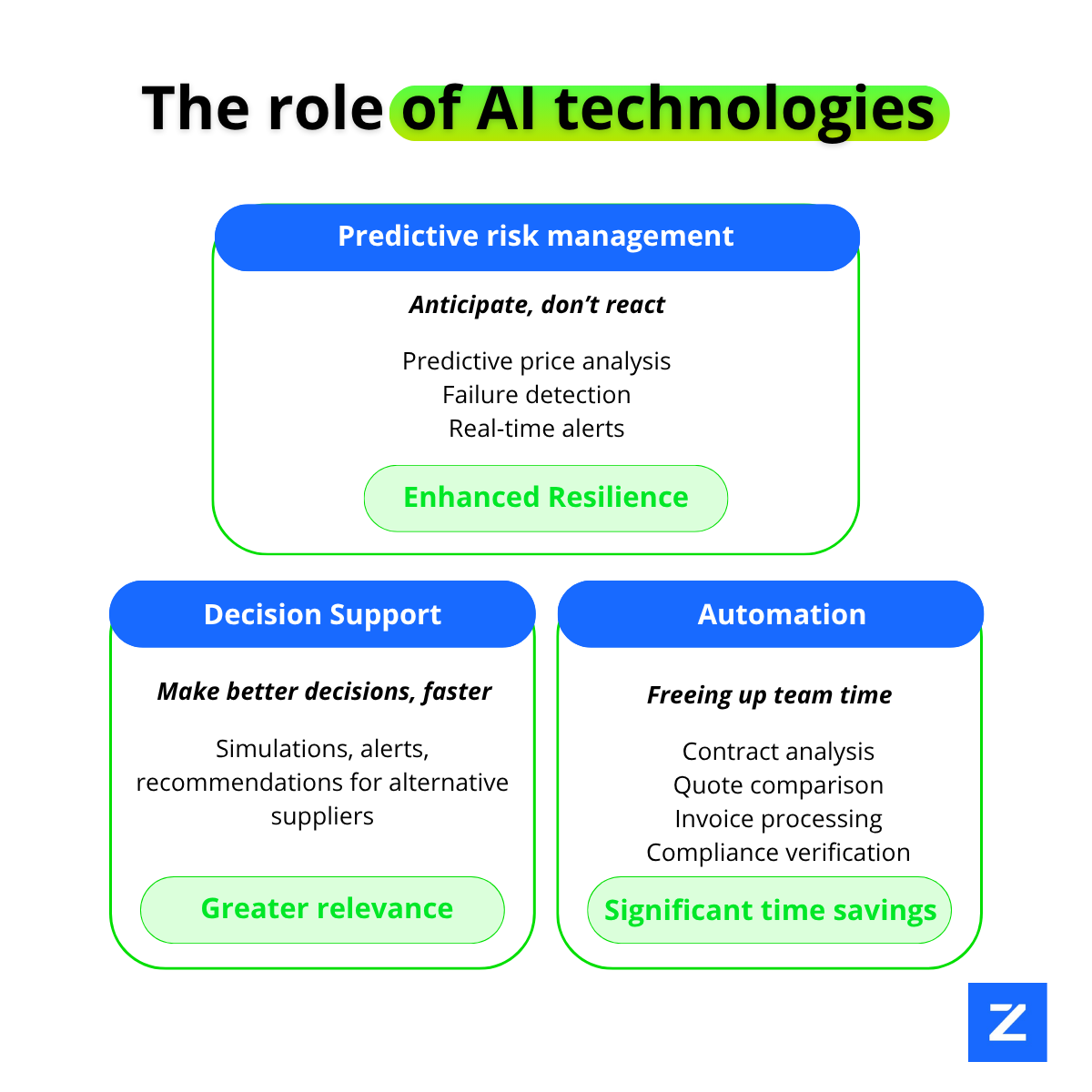
Automate low value-added tasks: contract analysis, bid comparison, invoice processing, compliance verification. These time-consuming tasks can now be handled by specialized AI agents.
Enhanced decision support: By cross-referencing internal data (purchasing history, supplier performance, contractual conditions) and external data (market trends, geopolitical risks, CSR indicators), AI provides more relevant, more objective and faster recommendations. It can anticipate supply disruptions, simulate the impact of renegotiation scenarios on margins, or recommend alternative suppliers based on archived data.
Predictive risk management: rather than being subjected to hazards, purchasing departments equipped with AI can anticipate them. Predictive price analysis, early detection of supplier failures, real-time alerts – AI transforms the purchasing function from a reactive to a proactive posture.
Lack of precision and traceability: an obstacle to performance
Integrating these technologies also raises a number of challenges. Data quality and traceability of actions remain essential prerequisites, and companies must ensure that they support their teams through the change.
AI fed on incomplete or unreliable data will produce insufficient results. This is why data governance is a strategic imperative before any automation project.
Traceability, meanwhile, ensures that every AI-assisted decision is documented, verifiable and compliant with regulatory requirements (RGPD, CSRD). In a context of increasing reporting obligations, this dimension is not insignificant.
Towards an enhanced purchasing function?
It’s important to remember one essential point: AI does not replace the buyer, itenhances him or her by providing more powerfuldecision-making tools. By automating transactional and repetitive tasks, it frees up teams for what constitutes their real added value: strategy, negotiation and supplier relationship management.
In this way,Artificial Intelligence is gradually transforming the purchasing function, making it more proactive, more agile and more strategic, marking an evolution towards a function that is augmented rather than replaced.
At ZYLIO, we offer AI agents specialized in the verification of purchasing documents in order to detect invoicing errors, price conformity, quote comparisons… because, today, 1 document out of 2 still escapes control and analysis.
These AI agents enable purchasing, finance and accounting departments to free up 70% of their time for less time-consuming, high value-added tasks.
Discover ZYLIO!