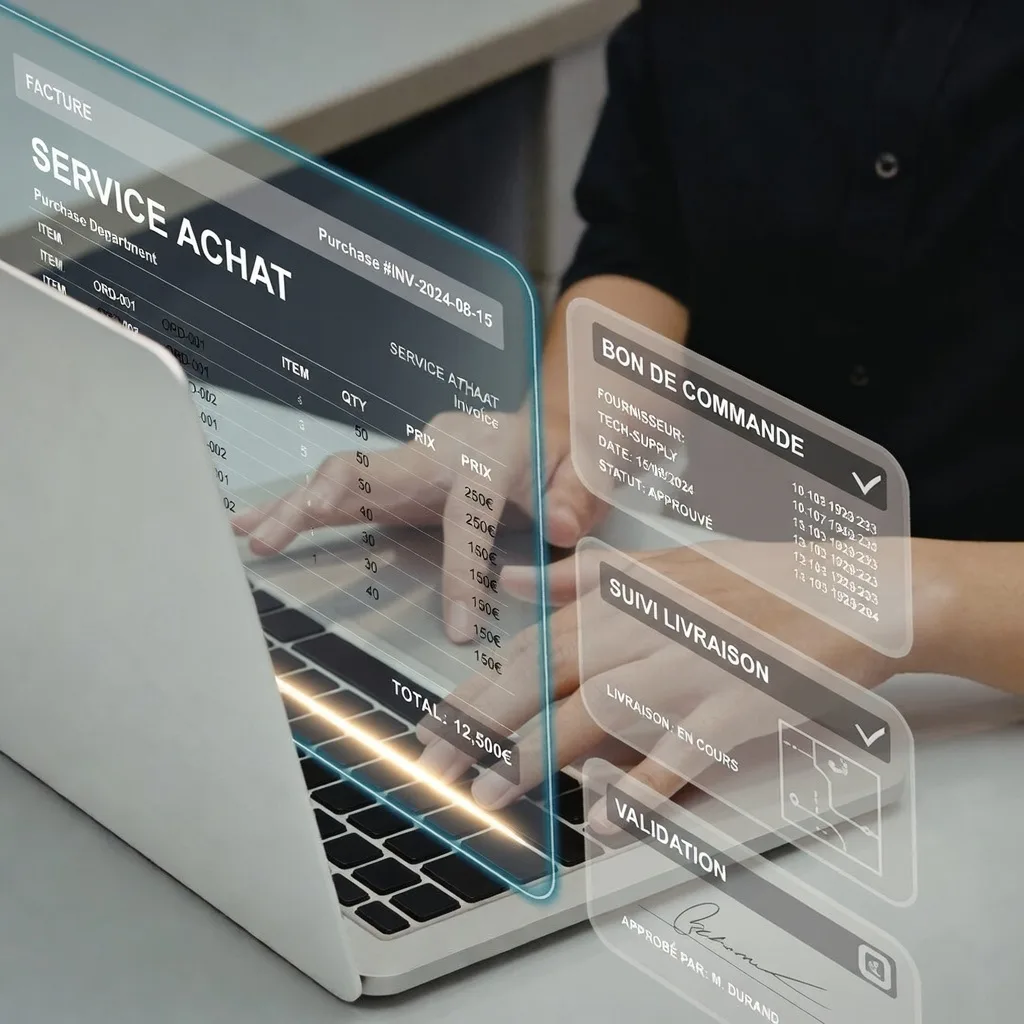

Contrary to a widespread belief, the value of AI in procurement has nothing to do with creativity. It comes from speed of detection. Reading documents that do not share a format, extracting the data that weighs on profitability, putting the negotiated rate next to the line actually invoiced: that is where AI makes a difference. That is why it has taken hold in procurement management and invoice tracking, on three tasks:
- compiling the documents of a purchasing file (quotes, BPU, DPGF, framework contracts, invoices) without retyping them;
- reading the decisive data and placing it in a common structure;
- confronting that data and surfacing the discrepancies, with proof.
What AI reads in a framework contract
A framework contract sets rebates, transport conditions, service levels and revision rules. AI combines natural language processing and vision models (VLMs) to read these contractual documents and extract the data that will count at invoicing time: unit prices, rebate tiers, free-delivery thresholds, penalties, revision indices.
Once the framework contract has been validated and analysed, that data forms a reference base ready for comparison. Profit centres and departments covered by the negotiated terms can then be told what departs from the agreement, in money or in service content:
- a framework rebate that was not applied;
- transport charges inconsistent with the free-delivery clause;
- product or service quality below the specification;
- after-sales service that does not match the commitment.
BPU and DPGF: reading without retyping
BPU (unit price schedules) and DPGF (global and fixed price breakdowns) are complementary documents, often long, sometimes in an unusual layout, and rarely readable at a glance. From a mass of disparate data, AI extracts the key information (nature of the service, quantities, prices, payment terms, due dates) and places it in a logical, usable structure.
That is the first step towards checking, once the contract is performed, that the negotiated terms are honoured. AI then identifies the problem data: the services and invoiced amounts that do not match the original schedule. Whether you write the BPU and DPGF or you are the contractor, the check works both ways:
- do the invoices received comply with the contractual documents?
- do the invoices issued respect the negotiated terms?
AI can also take the CCTP (special technical specifications) into account: it extracts qualitative data about the expected content of the service, to reconcile it with the specification validated at negotiation.
Standardising quotes to confront them with invoices
After reading, AI puts every quote into a common format: number and issue date, validity period, supplier and client details, line detail, special terms. This is the role of Compare, which puts offers on an equivalent basis, line by line. AI then cross-references that data with the invoices issued or received, and Compliance carries the check:
- Price compliance. The prices listed on invoices are compared with those of the compiled quotes, taking into account the terms negotiated upstream: volume rebates, framework contract, revisions. Discrepancies are documented, so the parties concerned (client, supplier, subsidiary) can be informed, proof attached.
- Content of the service. The quote is confronted with what was actually delivered. AI spots a pricing gap, but also a gap on the service itself: delivery lead time, assortment, after-sales service.
Gap analysis does not stop at the finding: every discrepancy is traced back to its source, with the document, the page and the line.
What it changes for the procurement team
The first effect is coverage. When reading no longer costs time, control is no longer restricted to the largest invoices or the strategic suppliers: it can cover the whole scope. On the scopes we have analysed, recovered margin sits between 1 and 7% of the scope analysed; that is an observed bound, not a promise.
The second effect is on the teams. The time spent retyping schedules and comparing columns in a spreadsheet is handed back to buyers and accountants, who use it to negotiate and arbitrate. The decision remains theirs: Zylio prepares the case, shows the proof and commits nothing without approval. It does not modify the ERP, contacts no supplier and trains no model on your data.
Where to start
Start from your own documents: one framework contract, its BPU, a few months of invoices. Compliance with negotiated prices can be launched on that scope without changing tools or processes. If you want to measure what that control yields on your data, a three-week diagnostic does it on the scope you choose.