
From generative AI to agentic AI: why this transition has become unavoidable for businesses
Since the launch of ChatGPT in November 2022, generative artificial intelligence has democratized at a spectacular rate. Today, having access to an LLM (Large Language Model) is no longer a competitive advantage: it’s a minimum requirement.
Now, the new trend that is set to revolutionize corporate competitiveness by optimizing and automating the purchasing process and internal corporate functions is agentic AI. Edouard de Mézerac, CEO of Artefact, explains in Inside the layers of the agentic revolution – Interview by TCG Summit.
That’s why many companies are already taking the plunge and integrating agentic AI into their offerings, such as Samsung, Google, OLX, Workday and Perplexity with its Computer tool.
Generative AI: a first revolution already outdated?
What is Generative Artificial Intelligence?
Generative Artificial Intelligence or Generative AI is a form of AI dedicated to the independent creation of data such as text, image, video and audio.
Generative AI relies on large AI models (base models) to produce ready-to-use solutions such as summaries, Q&A or any other type of content.
To achieve this, generative AI relies on statistical models trained on large corpora of data.
But this power has a fundamental limit: generative AI acts on instruction. It responds to a prompt, proposes a solution, generates a summary – but it’s the human who decides, validates and executes. In a context where purchasing departments have to process increasing volumes of supplier documents (quotations, BPU, DPGF, invoices, framework contracts), this conversational model is showing its operational limits.
Among the best-known generative AIs in their respective fields are :
For text: Chat GPT, Claude, Gemini
For images: MidJourney, DALL.E
For videos : Lumen5, Runway, Sora
For audio: Beatoven, Elevenlab, Suno
Agentique AI: autonomy at the service of performance
What is agentic AI?
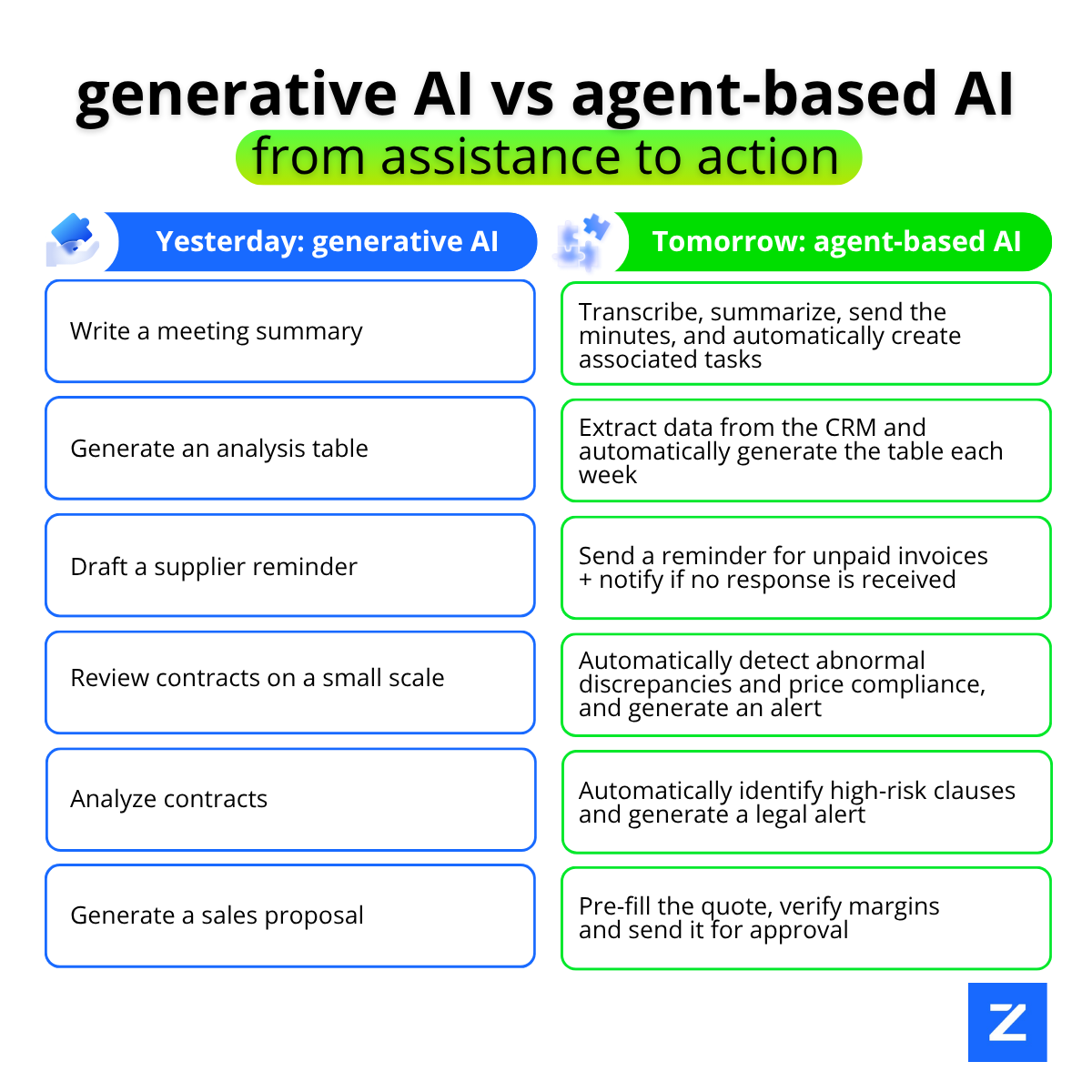
Agentic AI represents the natural evolution of generative AI. It doesn’t just produce content: it makes decisions, orchestrates workflows and dynamically adapts to its environment, with a high level of autonomy and little human intervention.
Where generative AI responds, agentic AI acts. It is this capacity for autonomous action that makes it a strategic lever with high ROI.
To achieve this, agentic AI builds on the foundations of generative AI to create a program capable of acting autonomously in a large, defined, real-world environment.
In other words, agentic AI builds on the strengths of each AI model to create high-performance agents with a high degree of autonomy.
Agentic AI comprises 6 types of agent
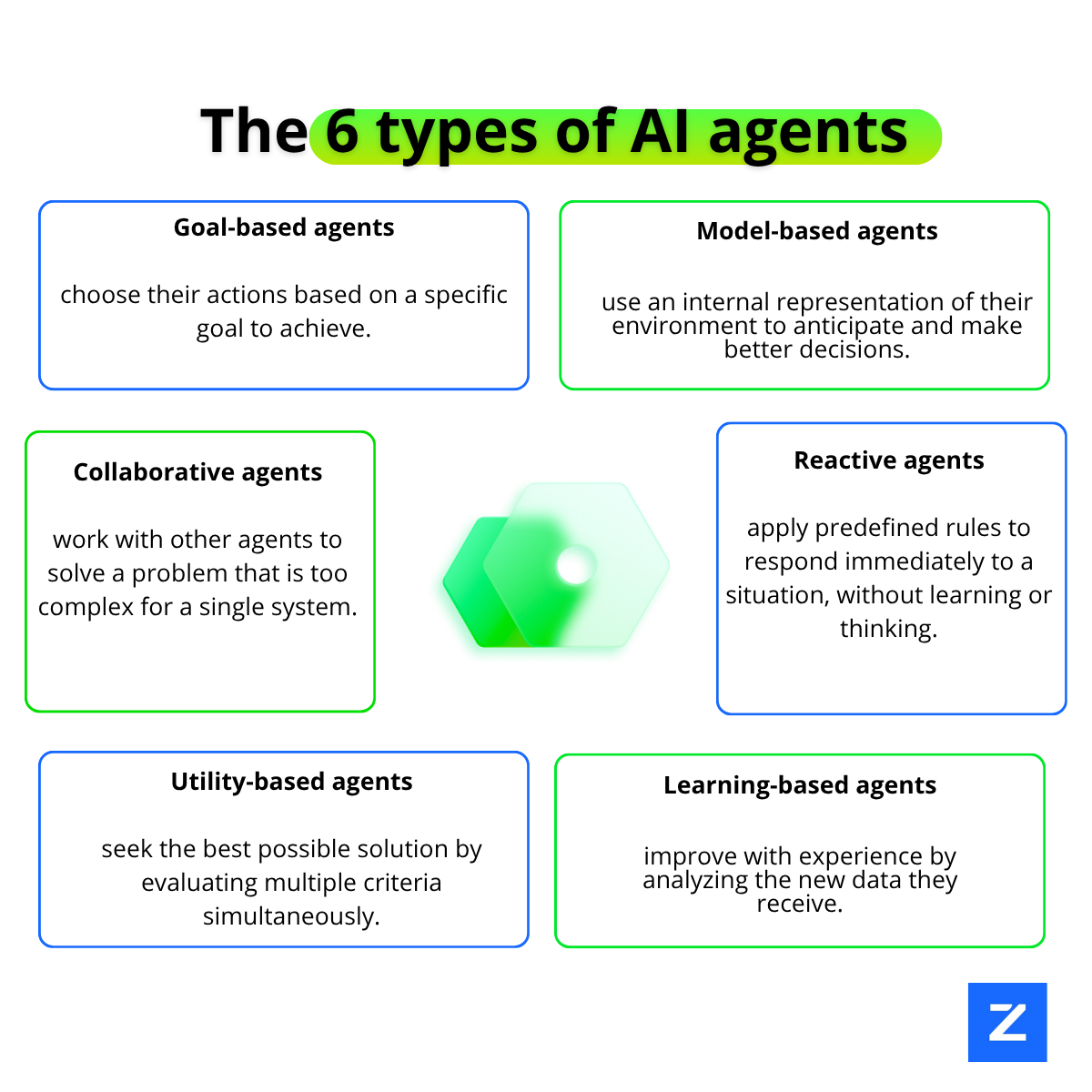
- Goal-based agents
These agents align every decision with the strategic objectives defined upstream. They are ideal for managing projects or processes where precision and efficiency are essential.
- Model-based agents
These agents help identify anomalies, better plan operations and reduce risks in partially known or changing environments. They are particularly useful for tracking process history and optimizing decision-making.
- Reactive agents
These agents automate repetitive tasks, reduce human error and free up time for higher value-added activities. For example, the automatic validation of alerts or financial thresholds can be entrusted to this type of agent.
- Learning-based agents
These agents enable continuous improvement of internal processes, rapid adaptation to market changes and a gradual reduction in errors, while increasing overall productivity.
- Utility-based agents
These agents balance competing objectives such as cost, lead time and quality, optimize resource allocation and enhance the overall performance of complex decision-making processes.
- Collaborative agents
This agent is a system that coordinates different agents with each other, automating decision-making in interdependent environments and minimizing human intervention in critical processes, thus offering maximum operational efficiency for a rapidly measurable ROI.
What's the difference between generative AI and agentic AI?
The main difference between generative Artificial Intelligence and agentic Artificial Intelligence is the capacity for automation, which lies in many aspects such as :
- Content creation
Generative AI alone generates articles, summaries or answers on demand
Agentic AI creates content only if required for action - Analysis & context
Generative AI alone analyzes data on demand
Agentic AI correlates information and context to decide on actions - Problem solving
Generative AI alone proposes solutions or best practices
Agentic AI automatically diagnoses and solves problems - Decision-making
Generative AI alone supports human decision-making
Agentic AI makes operational decisions according to defined rules - Autonomy
Generative AI alone has low autonomy, acts on prompt or instruction
Agentic AI has high autonomy with little or no human action, acts independently according to objectives - Personalization
Generative AI alone is based on immediate context
Agentic AI is based on long-term history and preferences
What are the benefits of agentic AI in business?
Agentic AI has many advantages, particularly when implemented in organizations’ internal processes.
Agentic AI can be integrated into all departments of a company, including customer service, purchasing, after-sales, finance, marketing, etc.
In what areas is agentic AI strategic?
Although AI agents can theoretically be integrated into all of an organization’s functions, some areas stand out for their immediate ROI potential:
- Customer service, by leveraging self-help capabilities to relieve team congestion
- Marketing and communications, by automating the adaptation of campaigns according to languages, markets and products
- IT by supervising operations, monitoring costs and proactively managing errors
- Purchasing and finance by analyzing contracts, comparing quotes and detecting billing anomalies
This last area is particularly strategic. As data from the field underlines: purchasing departments that automate discrepancy control and data reliability save an average of 70% of their administrative time, time that can be devoted to negotiation, strategy and supplier relationship management.
How to deploy agentic AI in your organization: 5 key steps
Implementing an agentic AI strategy can’t be improvised. It is based on an approach structured around five non-exhaustive stages:
- Step 1: Defining the problem to be solved
Identify the most time-consuming processes and the services for which automation would generate the most value.
Involve and question your employees: they’re the ones who know the most about day-to-day operational irritants.
- Step 2: Data quality
This is the absolute prerequisite. An AI agent can only be effective if the data it processes is reliable, structured and usable. Data governance is not a technical constraint, it’s a strategic imperative. It enables your system to understand your needs and your environment, and to build up a solid history.
- Step 3: Choosing the right tools
Once steps 1 and 2 have been successfully defined, think about the different agents to be integrated.
In-house development or ready-to-use solution? The choice depends on your resources, technological maturity and timeframe.
- Step 4: Tool integration
Successful adoption of agentic AI requires solid human support. AI agents don’t replace teams, they augment them. Training employees, communicating progress and integrating feedback from the field are key success factors. RGPD compliance and security requirements must also be anticipated right from this phase.
- Step 5: Test, monitor and admire
The first few months are crucial: monitor performance indicators (time savings, cost savings, anomaly detection rates), adjust parameters if necessary and measure results.
Agile AI in purchasing
At Zylio, we offer AI agents specialized in the verification of purchasing documents in order to detect invoicing errors, price conformity, quote comparisons… and enable purchasing, finance and accounting departments to free up 70 % of their time for less time-consuming, high value-added tasks.
Discover Zylio!